Close-up magic, also called strolling, walk-around, or mingling magic, is magic that comes to your guests instead of asking them to sit down and watch. Michael Bloemeke moves through your event from group to group, and the magic happens a few feet from their faces, often in their own hands.
This style of performance is designed for when you need interactive entertainment flowing through the event and not taking up a slot in the schedule. Close-up magic is perfect for when people are mingling and socializing during a cocktail hour or reception.
Check your date for close-up magic
- Guests who arrive not knowing anyone have an easy way in
- Different departments, or the two sides of a wedding, end up laughing together
- The quiet stretch before dinner becomes the part people bring up afterward
Coverage. Raleigh, Durham, Charlotte, and all of North Carolina
Insured. Certificate of insurance sent to your venue on request
Check AvailabilityWhat close-up magic looks like at your event
Michael arrives at the venue before the guests, ready to go, and checks in with the planner or the client. All he needs is somewhere to leave his keys and a few spare decks. After that he works out of his pockets.
As guests arrive, he starts. He walks up to a group, introduces himself, and performs for a few minutes before moving to the next one, mingling as part of the crowd and working in line with whatever schedule has already been set.
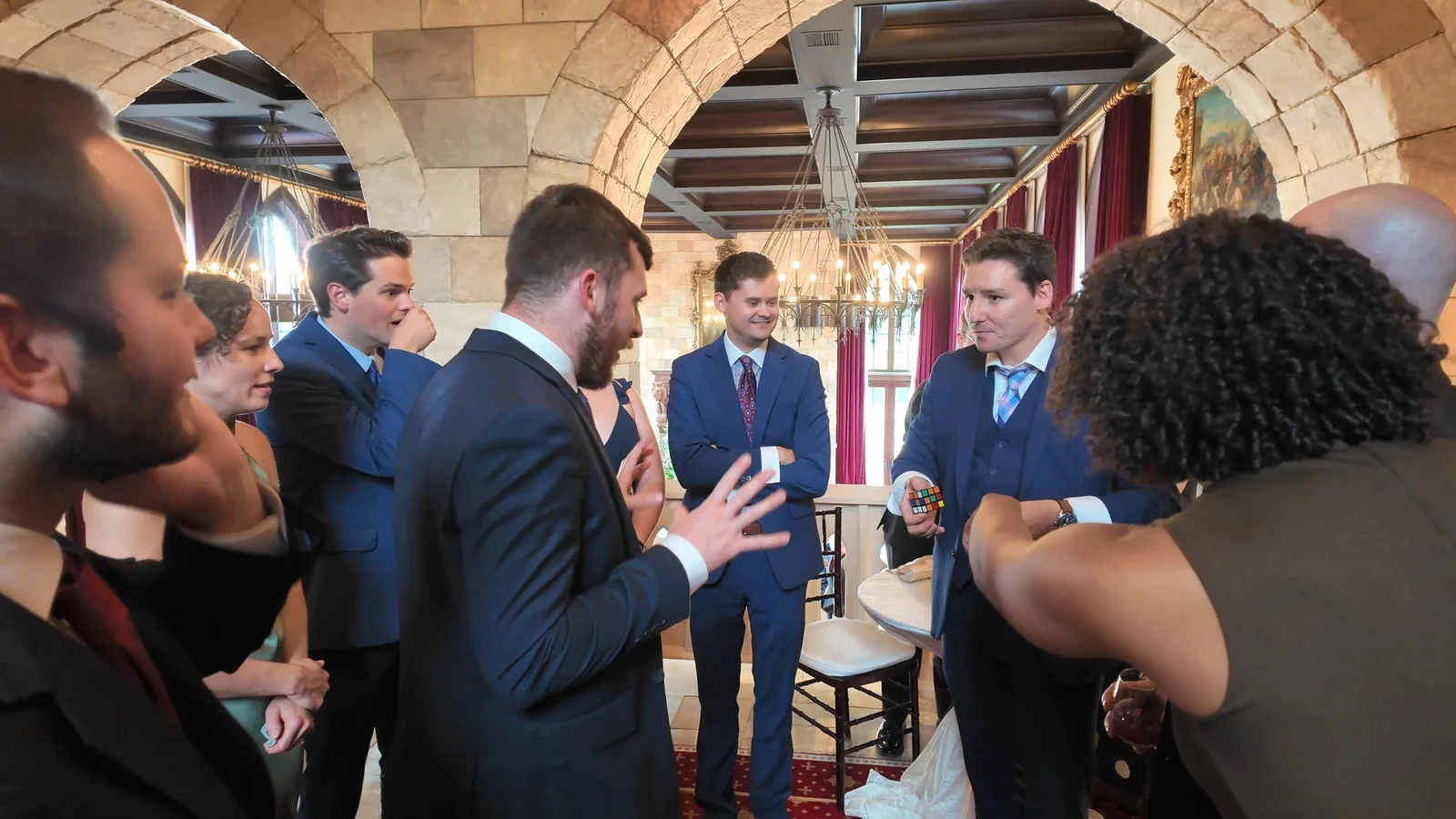
The magic is conversational, and there is no fourth wall. The tricks are specially chosen so the guests are active participants in the magic, with the cards in their hands rather than his, whether that is helping to shuffle the deck, having objects change or disappear, or having something they only thought about read back to them.
He keeps moving, so the magic goes wherever it is most needed, whether that is a group he reads from across the room or a group that calls him over and asks to see something.
Some nights he stops moving. He will be partway through something for one group, another drifts over before he finishes, the first group peels off, more arrive behind them, and guests start coming to one spot on their own. That happens by itself when a crowd is having fun, and it is a good sign when it does. He stays put and holds court, usually near a lounge area or the bar tables, pulling people in as they arrive, and goes back to working the room when the rotation dries up. The whole thing runs on reading the room, and Michael shifts with whatever the environment calls for.
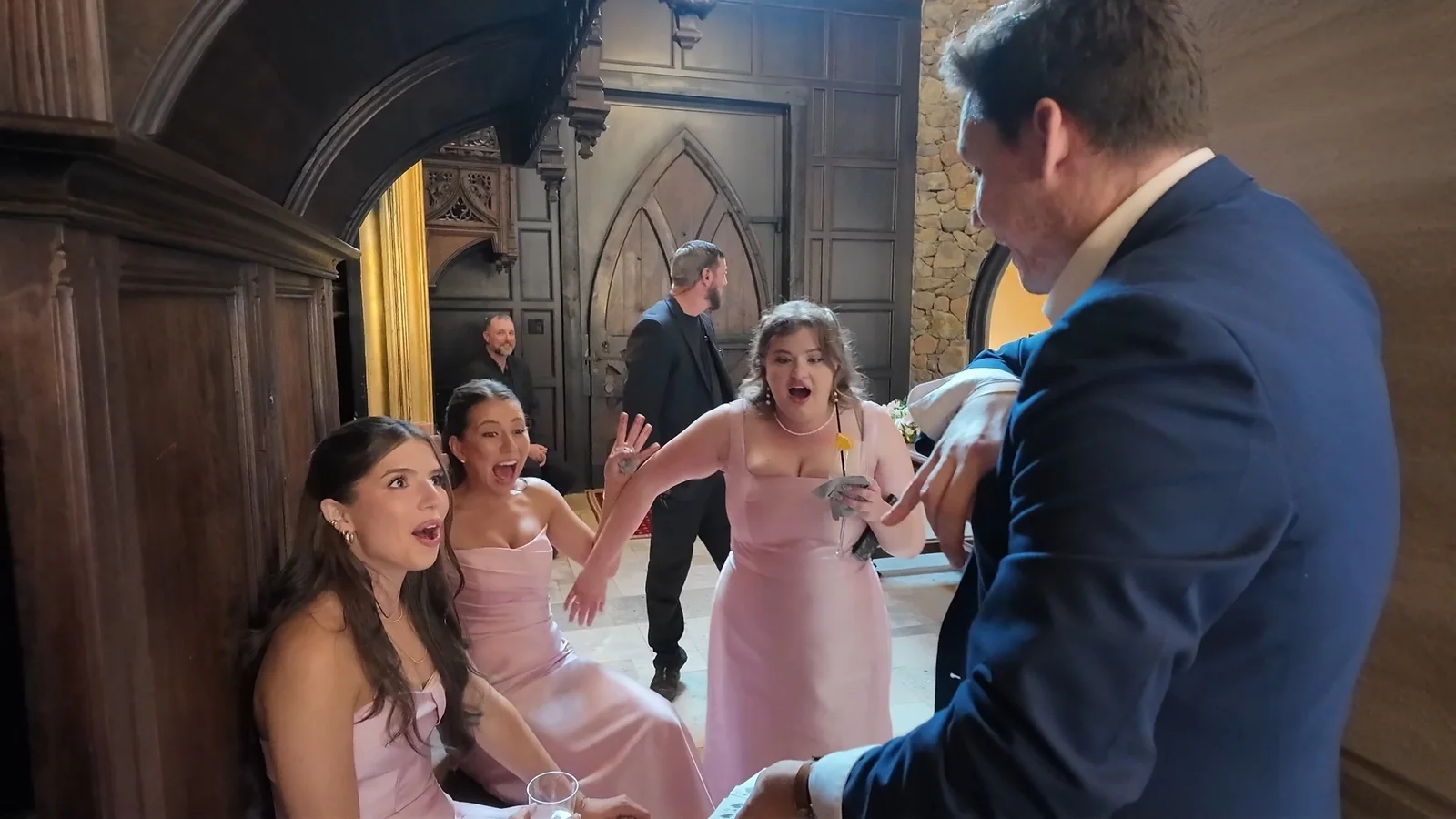
He needs no table for any of it. Everything works standing up, with guests holding drinks, and where there are bar tables or cocktail tables he uses them. At a seated dinner he goes table to table.
The material is a mixture of card work, mind reading, and tricks with everyday objects, so there is something for everyone. All of it is clean and family friendly. While most of Michael's events are corporate or adult, any time there are younger guests he is able to include them so they get to enjoy and be a part of the magic as well, without the night turning into a kids' show.
Close-up magic carries well past the group Michael is standing with. Quiet conversation turns into laughs and screams of amazement, and those reactions are heard across the room. The energy and the mood of the whole event lift with them. Word gets around that there is a magician, and before long people are coming up to Michael and asking him to perform for their group.
Why hire a close-up magician?
Most events have a stretch where there is nothing to do. Guests arrive, get a drink, and stand in a circle with people they may not know, waiting for dinner, or for the couple to finish their photos. A band or a slideshow is something to have in the background. Close-up magic is something to be part of, and it gives people who would never walk up to a stranger a reason to stand together and laugh.
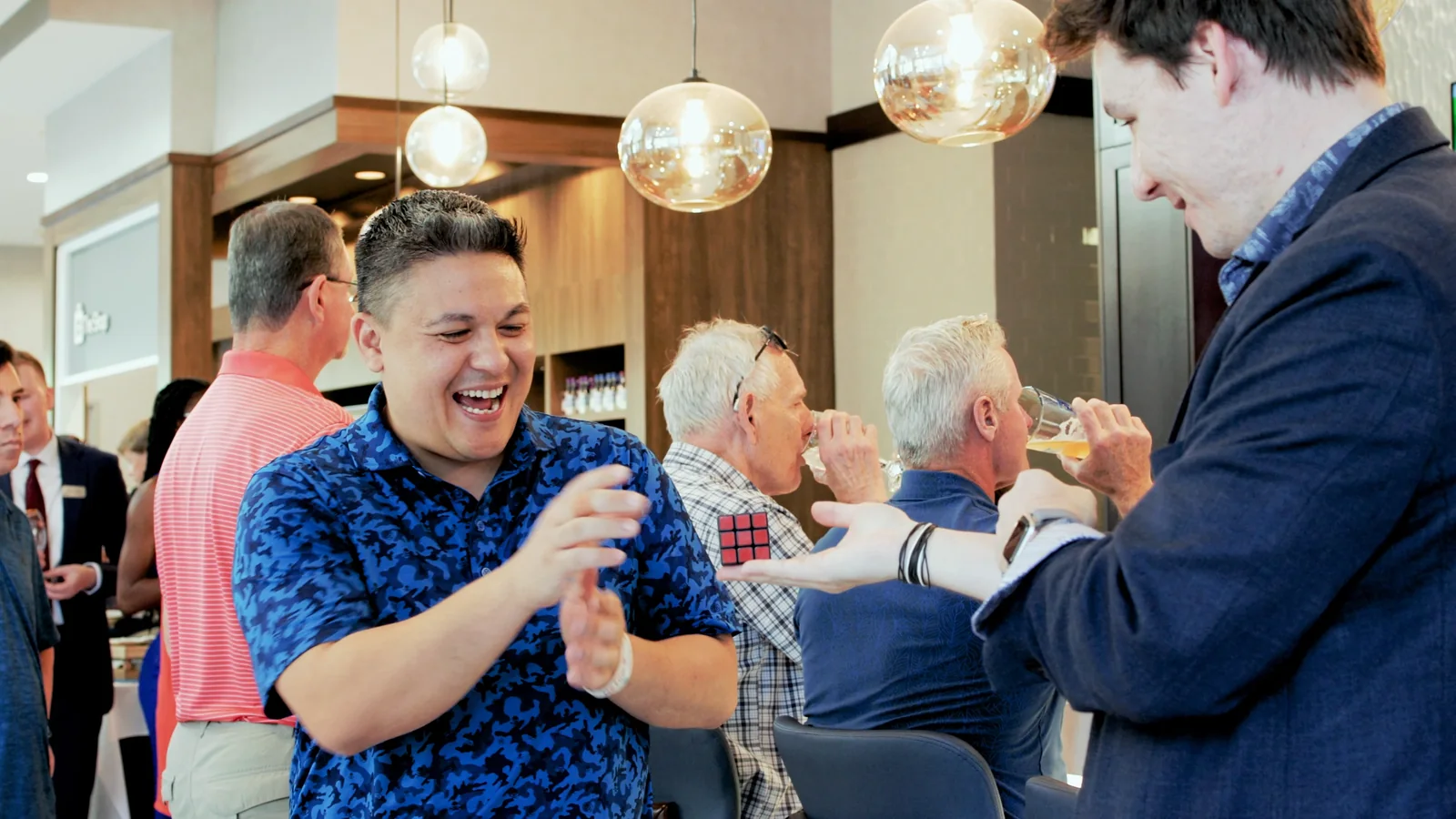
It is also rare. Nearly every event has a photo booth, and most guests have sat through years of holiday parties without ever seeing a magician at one. That on its own makes an event stand out, and it hands everybody there something they are still describing to people afterward.
It fits where very little else does. A cocktail hour, a reception, the half hour while guests arrive and wait on dinner: close-up magic runs through all of it without taking a slot in the schedule and without anything being announced.
Most of all, it puts people together. Michael performs with a group rather than at them. Guests are holding the cards, calling things out, and working out between themselves what just happened, and when he moves on he regularly overhears the group he has just left swapping theories about it.
That counts for the most in a room where people do not know each other. At a wedding, half the guests know only one side of the couple. Michael will start something with one group, wave the people standing nearby into it, and perform for both at once. When he moves on, two sets of guests who had never spoken are standing together with something to talk about besides sports and the weather. The same thing works at a corporate event, where the point is often getting departments who never cross paths into the same conversation.
"He roamed our event, mingling with the crowd as planned and always drew an audience. He was affable and outgoing and easily initiated interactions."
"Michael joined our July 4th luncheon at work. He walked around to the team throughout the building sharing magic tricks. Our team thoroughly enjoyed the variety of tricks he performed, and our business was filled with awes and laughter."
"He spent time moving from table to table, interacting with guests and creating a fun, personalized experience for everyone. The format worked perfectly for our group, and he kept people entertained for hours."
Read all 400+ five-star Google reviews
Where close-up magic fits
Wedding cocktail hours
While the couple is away for photos and the two families are meeting for the first time. See weddings.
Corporate receptions and holiday parties
Before dinner and the program, when coworkers stand with the people they already know. See corporate events.
Networking and client events
Conference receptions, client appreciation nights, and open houses, where getting strangers talking is the whole point.
Galas and fundraisers
Including casino nights, where card magic fits right in next to the tables.
Picnics, family days, and grand openings
Crowds that come and go over a few hours, indoors or out.
Large private parties
Milestone birthdays and family reunions with fifty guests or more.
Close-up magic and the formal show together
Close-up magic stands on its own at plenty of events, and it is a great fit for a cocktail hour or a reception, but it is also the perfect complement to the formal show.
Michael does both at a lot of events. The close-up magic gets everybody warmed up and talking, and it means he is not a stranger by the time the show starts. Guests have already met him and seen him perform, so the show opens on a crowd that is ready for it.
He gets to know the guests as well. The show brings people up to help and calls on others where they are sitting. An evening of close-up magic first gives Michael a sense of who would be a good fit for which parts of it. Jokes from the cocktail hour come back during the show, and guests he performed for earlier end up part of it again.
You do not have to pick one or the other. The two work together really well. In fact, this is one of the most common formats for a corporate holiday party. As guests arrive, Michael performs close-up magic all through the room, getting people talking and socializing and getting the energy up. Then he goes off to the side to set up his show while everybody has dinner, and the evening moves on to speeches and end-of-year awards. After that, Michael comes back and closes out the program with the formal show for everyone.
What you are paying for
The entertainment is the one part of the night that cannot be redone. A close-up magician is not paid for tricks. Anyone can buy a trick. You are paying for:
- Someone who can walk up to a group of strangers mid-conversation and be welcome within seconds, read which guests want more and which want to be left alone, and keep a room moving for two hours without a dead spot.
- Over a decade of experience thinking on his feet. Michael reads what the situation calls for and adjusts, whether that means staying in one spot or changing how he works to fit the performing environment.
- Award-winning material, performed at a level that has earned recognition around the world.
- Liability insurance. If your venue asks for proof, Michael can send a certificate of insurance straight to them at a moment's notice.
Pricing is flexible. It depends on what Michael is doing, the guest count, the type of event, how long he performs, and the date. Michael's events can range anywhere from under $1,000 to $3,000 and up.
Quick facts
- How long
- Ninety minutes to two hours is typical. Forty-five minutes at the least.
- How many guests
- Fifty or more. For smaller groups, the formal show.
- What it needs
- Nothing but a place to leave a small bag.
- Booking
- Most events book two to three months out. December goes first.
Who this page is for
This page is for planners, couples, and hosts who want entertainment that moves through the room while guests mingle. If you want everyone seated and watching together, the page you want is the formal show. If you are planning a specific kind of event, the corporate events and weddings pages walk through the whole night.
How booking works
-
1Fill out the formFill out the formInclude as much information as you are able to provide, and Michael will follow up with you personally.
-
2Talk it throughTalk it throughYou and Michael hop on a short call, and he walks you through every last detail. Together you go over the different packages and performance styles and figure out what works best for your event. Afterward you get a written proposal with all the details included.
-
3Lock it inLock it inSign the performance agreement and pay the invoice, and you are all set. Michael checks in as the date gets closer and handles the details with you or your planner.
Why book Michael for close-up magic in North Carolina?
Michael offers an experience that you cannot get anywhere else. He is a professional magician based in Raleigh, North Carolina, and he has been performing professionally for over a decade, at corporate events, weddings, galas, and private parties all over the country, and internationally as well.
Michael is a multi-award-winning entertainer. In 2025 he represented the United States at the FISM World Championship of Magic in Turin, Italy, and won the title of Most Original Act for his close-up magic. FISM is often called “the Olympics of Magic,” and the Most Original Act category honors creativity at the highest level the art form recognizes. It is a credential most magicians never come close to.
He is also the 2022 International Brotherhood of Magicians Close-Up Champion (with the People's Choice award the same year), a Brad Jacobs People's Choice recipient, and he has been awarded a “Masters of Magic” degree from the prestigious invite-only 4F Convention.
Michael's work has been featured on The CW's Masters of Illusion nationally and on Charlotte Today (WCNC) locally. He performed as part of the cast of The Magician's Table, the London-originated magic-theater show now touring nationwide, and he has more than 400 five-star Google reviews from corporate planners, event coordinators, wedding couples, and private hosts across North Carolina and beyond singing his praises.
Michael will recommend what works best for your event, and the entertainment is one less thing for you to worry about. If you want your guests to have the time of their lives, you cannot go wrong with Michael Bloemeke's Award-Winning Magic.
Questions about close-up magic
What is close-up magic?
Close-up magic is magic performed a few feet from the audience, for a few people at a time, usually with their own hands doing part of the work. At an event, the magician moves through the room from group to group instead of performing on a stage, so guests never have to stop what they are doing to watch.
Is close-up magic the same as strolling, walk-around, roaming, or mingling magic?
Yes. Those are all names for the same thing: a magician moving through your event and performing for small groups. Michael calls it close-up magic because that is the name most people recognize, but whichever word you searched for, this is the page.
How many guests can one close-up magician cover?
Plenty. In a typical ninety-minute cocktail hour Michael reaches a large share of a room of a hundred or more, and he circles back to groups he has already visited. For three hundred guests or more in a single hour, a second magician is worth adding, and Michael can recommend one he trusts.
How long should we book close-up magic for?
Most events book ninety minutes to two hours, the length of a normal cocktail hour or reception. Michael recommends at least forty-five minutes so every part of the room gets a visit. It is not a scripted show, so if your schedule runs long, he keeps going.
What is the smallest group close-up magic works for?
Close-up magic works best with roughly fifty guests or more. With a dozen people, the magician covers the room in minutes and everyone gathers to watch anyway. For smaller groups Michael recommends the formal show, which keeps the same interactive feel and is planned for everyone at once.
Does close-up magic need a stage, a table, or a sound system?
No. Michael works from his hands and his pockets, so there is nothing to set up. The only thing he asks for is a closet, an office, or a vendor room where he can leave a small bag.
Can you perform during dinner?
Not during the meal itself. Food, conversation, and magic all compete with each other at dinner, and nobody wants to help with a trick while their plate gets cold. Michael performs while guests arrive and mingle, steps back while people eat, and can pick back up afterward.
What if some guests don't want to watch?
That is fine, and Michael notices. Some people want five tricks and some want none. He reads each group, gives the enthusiastic ones more, and leaves a conversation alone when the people in it are clearly deep in something important. Nobody is dragged into anything.
Can you work a crowd that comes and goes?
Yes, and that is exactly what close-up magic is for. At an open house, a picnic, or a reception where guests arrive over an hour, Michael keeps track of who he has not reached yet and finds them.
Should we tell our guests there will be a magician?
Yes, if you can. When guests know a magician is coming, they wave him over. When they do not, the first minute with every group goes to figuring out who he is. A line in the welcome remarks or on the program is plenty.
Can the magic be customized for our event?
Often, yes. Tell Michael about the VIPs, the guest of honor, or the skeptic everyone wants him to win over, and those people get extra attention. He can lean into a theme too, like more card magic at a casino night.
What kind of magic will guests see?
A mix. There is sleight of hand with cards, plenty that has nothing to do with cards, and mind reading played as a game. Much of it happens with the guests' own hands and belongings, which is why they remember it.
Does Michael carry liability insurance?
Yes. Michael carries liability insurance, and if your venue needs a certificate of insurance, he sends it to them directly.
How much does a close-up magician cost?
Michael's events range from under $1,000 to $3,000 and up, and most fall between $1,000 and $3,000.
The date, the length, the guest count, and whether you pair close-up magic with the formal show all play a part. The form is the quickest way to an exact number.
Book now and make your event amazing.
Check AvailabilityWhere Michael performs
Michael performs all across the United States and beyond. He is based in the Raleigh-Durham area, so most of his events take place in North Carolina, including:
- Raleigh
- Durham
- Chapel Hill
- Cary
- Apex
- Morrisville
- Wake Forest
- Holly Springs
- Fuquay-Varina
- Garner
- Knightdale
- Clayton
- Hillsborough
- Research Triangle Park
- Charlotte
- Concord
- Huntersville
- Cornelius
- Mooresville
- Gastonia
- Greensboro
- Winston-Salem
- High Point
- Burlington
- Fayetteville
- Pinehurst
- Southern Pines
- Sanford
- Wilmington
- Greenville
- Rocky Mount
- Wilson
- Goldsboro
- New Bern
- Jacksonville
- Asheville
- Boone
- Hickory